How Researchers Can Use AI to Study and Research More Effectively
August 27, 2026
How Researchers Can Use AI to Study and Research More Effectively
Research is becoming increasingly complex. Researchers today have access to an enormous amount of academic literature, online publications, datasets, reports, technical documentation, and other sources of information. Finding useful information is important, but understanding, organizing, comparing, and applying that information can take an enormous amount of time.
Artificial intelligence can help researchers work more efficiently by supporting tasks such as exploring research topics, understanding complex concepts, analyzing academic papers, organizing literature, developing research questions, identifying potential research gaps, reviewing academic writing, and preparing research presentations.
However, effective AI research is not about allowing artificial intelligence to replace researchers. The best approach is to use AI as a productivity and research-support tool while keeping human expertise, critical thinking, and scientific judgment at the center of the process.
In this guide, we will explore how researchers can use AI to study and research more effectively and how tools such as EbraTech AI Secretary can help make online research workflows more efficient.
Why Researchers Are Using AI
Researchers often spend a significant amount of time processing information. A single research project can involve reading hundreds of papers, comparing different methodologies, collecting information, analyzing arguments, searching for additional sources, and preparing written material.
AI can help with some of these repetitive and information-heavy activities.
Researchers can use AI to brainstorm ideas, analyze information they provide, explain complicated concepts, compare research findings, identify potential weaknesses in an argument, and improve the structure of their work.
The important point is that AI should support the researcher's work rather than replace the researcher's expertise.
1. Use AI to Explore New Research Topics
Research projects often begin with a general area of interest. Turning that broad interest into a specific and useful research topic can require significant brainstorming.
AI can help researchers explore different possibilities.
For example, a researcher interested in renewable energy could ask:
"Give me 15 potential research topics related to renewable energy adoption. Group them into technological, economic, environmental, and policy-related areas."
The researcher can then investigate these ideas using academic databases and existing literature.
AI-generated suggestions should be treated as starting points rather than established research opportunities.
2. Use AI to Develop Research Questions
A strong research question provides direction for an entire research project.
Researchers can use AI to transform broad topics into more focused questions.
For example:
Broad topic: Artificial intelligence in healthcare
Focused topic: AI-assisted medical diagnosis
Potential research question: How does AI-assisted diagnosis affect the accuracy and efficiency of medical decision-making?
A researcher could ask:
"Generate 10 research questions based on this topic. For each question, suggest possible variables, methodologies, research populations, and limitations."
This can make the initial brainstorming stage faster and more structured.
3. Use AI to Understand Complex Research Concepts
Modern research frequently crosses disciplinary boundaries. A researcher may need to understand concepts from statistics, programming, economics, engineering, biology, computer science, psychology, or another field.
AI can provide an initial explanation of unfamiliar concepts.
For example:
"Explain this machine learning algorithm at an advanced research level. Explain how it works, its assumptions, common applications, limitations, and situations where it should not be used."
This can help researchers build an initial understanding before consulting textbooks, academic papers, and specialist sources.
4. Use AI to Analyze Academic Papers
Reading research papers is one of the most important parts of academic research, but researchers often need to process a large number of papers.
AI can help researchers analyze information from papers they provide.
Useful questions include:
- What is the main research question?
- What research gap does the paper address?
- What methodology was used?
- What are the main findings?
- What are the limitations?
- What assumptions does the research make?
- What future research does the author suggest?
For example:
"Analyze this research paper and identify its research question, methodology, main findings, limitations, theoretical contribution, and recommendations for future research."
Researchers should still read important papers themselves and verify AI-generated interpretations against the original publication.
5. Use AI During Literature Reviews
Literature reviews can require researchers to examine a large number of academic publications.
AI can help organize information and identify patterns within material that researchers provide.
For example:
"Compare these research papers by research question, methodology, sample size, dataset, findings, limitations, and conclusions."
Researchers can also ask:
"Identify the major themes across these studies and explain where the researchers agree and disagree."
This can help researchers create a more organized understanding of a large body of literature.
6. Use AI to Compare Different Research Studies
Two studies may investigate similar topics but use completely different methodologies or datasets.
AI can help researchers structure these differences.
For example:
"Compare these five studies and explain how their methodologies could influence their different conclusions."
This type of analysis can help researchers identify methodological differences that might otherwise be overlooked.
7. Use AI to Identify Potential Research Gaps
Finding a meaningful research gap is one of the most important steps in developing a research project.
Researchers can provide relevant papers and ask AI to identify possible gaps.
For example:
"Based on these studies, identify potential theoretical, methodological, geographical, technological, and population gaps that could be investigated in future research."
This can generate useful ideas for further investigation.
However, researchers should never assume that an AI-generated research gap is automatically valid. The proposed gap should be checked through a comprehensive review of the relevant literature.
8. Ask AI to Challenge Your Research
Researchers can use AI not only to support their ideas but also to challenge them.
This can be particularly useful before submitting a paper or research proposal.
Try asking:
"Act as a critical peer reviewer. Identify the strongest weaknesses in my research argument and explain what evidence could challenge my conclusions."
You can also ask:
- What assumptions am I making?
- What alternative explanations should I consider?
- What evidence could contradict my hypothesis?
- What methodological weaknesses could reviewers identify?
- What parts of my argument require stronger evidence?
Using AI as a critical thinking partner can help researchers identify weaknesses before submitting their work.
9. Use AI to Improve Research Methodology
Researchers sometimes need to choose between different methodologies or evaluate whether a proposed methodology is appropriate for a particular research question.
AI can help researchers explore methodological options.
For example:
"Compare qualitative interviews, surveys, experiments, and observational studies for investigating this research question. Explain the strengths, weaknesses, potential biases, and appropriate use cases of each method."
AI should not replace consultation with methodological experts or established academic literature, but it can help researchers formulate better questions and understand available options.
10. Use AI to Prepare Research Surveys and Interviews
Researchers conducting surveys or interviews can use AI to brainstorm potential questions.
For example:
"Generate potential interview questions for a qualitative study investigating how university students use AI for learning. Group the questions into background, behavior, experience, benefits, concerns, and future expectations."
Researchers should carefully review every question to avoid leading questions, ambiguity, bias, or problems with research ethics.
11. Use AI to Prepare Research Presentations
Researchers often need to present complicated findings at conferences, seminars, meetings, and academic events.
AI can help researchers structure presentations around their most important findings.
For example:
"Create a 15-minute academic conference presentation structure based on this research. Identify the most important findings and suggest how to explain them to an audience outside my specific research field."
This can help researchers communicate complex research more clearly.
12. Use AI for Academic Writing Feedback
Researchers can also use AI to review their academic writing.
Rather than asking AI to write an entire research paper, researchers can ask it to identify weaknesses in their own writing.
For example:
"Review this section for clarity, logical structure, academic tone, unsupported claims, repetition, and inconsistencies. Identify problems without changing the meaning."
AI can help identify:
- Unclear sentences
- Repeated arguments
- Weak transitions
- Inconsistent terminology
- Logical gaps
- Ambiguous statements
- Potentially unsupported claims
The researcher should decide which suggestions are appropriate for the research.
13. Use AI to Prepare for Peer Review
Before submitting a manuscript, researchers can ask AI to simulate the perspective of a critical reviewer.
For example:
"Act as a peer reviewer for a scientific journal. Evaluate the research question, methodology, data, analysis, results, discussion, limitations, and conclusions. Identify the most serious weaknesses."
You can then ask:
"Which issues are most likely to result in major reviewer criticism, and how could I strengthen the manuscript?"
This does not replace real peer review, but it can help researchers identify potential problems before submission.
14. Use AI to Organize Research Notes
Long research projects can produce a large amount of information.
Researchers may have notes from papers, websites, interviews, meetings, reports, and datasets.
AI can help organize information into categories, themes, questions, or research areas.
For example:
"Organize these research notes into major themes. Under each theme, identify supporting evidence, contradictory evidence, unanswered questions, and sources that require further investigation."
This can make it easier to return to important ideas later in the research process.
15. Use AI for Interdisciplinary Research
Interdisciplinary research requires researchers to understand concepts outside their primary area of expertise.
AI can help provide an initial overview of another discipline.
For example, an environmental researcher may need to understand machine learning.
They could ask:
"Explain the most commonly used machine learning methods in environmental research. Include their typical applications, required datasets, advantages, limitations, and examples of research questions."
The researcher can then use academic literature to investigate the most relevant areas in greater depth.
16. Use AI While Researching Online
Researchers increasingly conduct research through web browsers. They may read journal articles, reports, university pages, technical documentation, government publications, datasets, and other online sources.
One challenge is moving efficiently from the information being viewed to useful AI-assisted questions.
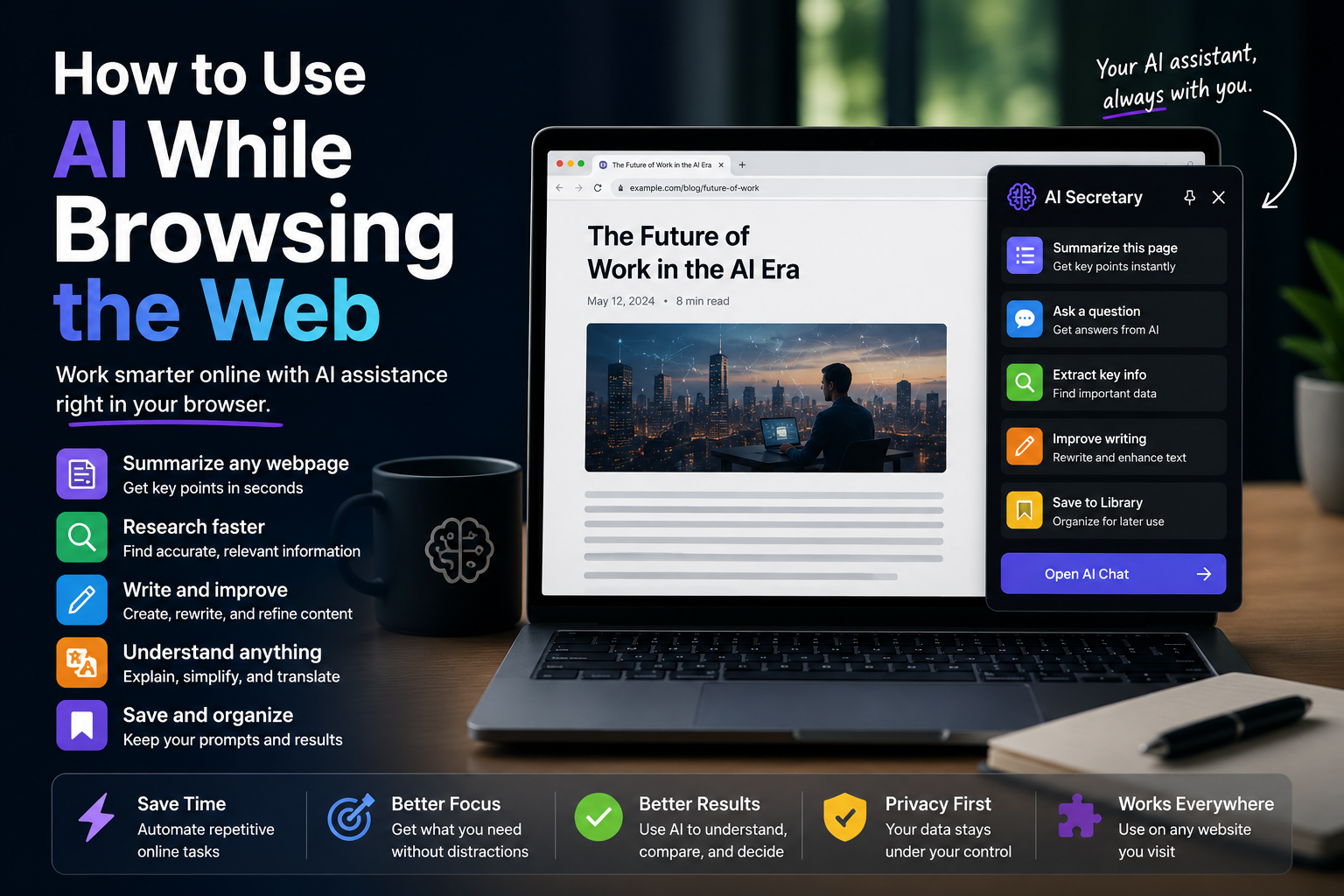
EbraTech AI Secretary is a Chrome extension designed to help users work with webpage context and selected content and prepare prompts for compatible AI services.
For example, while reading an online research article, a researcher may want to ask:
- What is the main argument?
- What evidence supports the author's conclusion?
- What limitations should I investigate?
- What research questions emerge from this article?
- How does this research compare with other studies?
- What should I investigate next?
A contextual browser workflow can make it easier to move from online reading to structured AI-assisted research.
17. Reduce Repetitive Research Tasks
Researchers frequently perform repetitive browser activities such as copying text, switching between tabs, creating similar prompts, and moving information between applications.
Tools designed around browser-based AI workflows can reduce some of this repetitive work.
EbraTech AI Secretary helps users work with webpage context and selected text and prepare prompts for compatible AI services.
A simple workflow can look like this:
Open a research page ? Select useful information ? Prepare a relevant prompt ? Use your preferred AI service ? Review the response ? Verify important information.
18. Use AI as a Research Assistant, Not a Replacement
The most effective researchers will not necessarily be those who use AI the most. They will be those who understand when AI is useful and when human expertise is essential.
AI can help researchers process information and generate possibilities, but researchers are still responsible for scientific reasoning, interpretation, methodology, ethical decisions, and conclusions.
A useful principle is:
Use AI to accelerate research, not to outsource research judgment.
19. Verify AI-Generated Information
Researchers should always verify important information generated by AI.
AI systems can sometimes produce incorrect facts, misunderstand research papers, misinterpret statistics, provide outdated information, or generate inaccurate citations.
Important information should be checked against reliable sources such as:
- Peer-reviewed journals
- Original research papers
- Academic databases
- Official datasets
- Government publications
- University research
- Primary sources
AI should help researchers investigate information, not become the final authority for scientific conclusions.
20. Be Careful With Confidential Research Data
Researchers should be particularly careful when using AI with sensitive information.
Do not automatically upload confidential research data, unpublished research, private participant information, student records, proprietary information, trade secrets, or other sensitive materials.
Before using an AI service with research data, researchers should review their institution's policies, research agreements, ethical requirements, publisher policies, and the AI service's terms.
When in doubt, avoid entering sensitive information until you have confirmed that doing so is permitted.
21. Follow Research Ethics and Institutional Policies
AI policies can vary between universities, research institutions, journals, conferences, and funding organizations.
Researchers should understand the applicable rules before using AI in their research.
Depending on the institution and project, policies may address:
- AI-assisted writing
- Research data privacy
- Participant information
- AI disclosure
- Copyright
- Academic integrity
- Publication requirements
- Research ethics
Responsible AI use is an important part of modern research practice.
Useful AI Prompts for Researchers
Research Topic Exploration
"Give me 10 emerging research topics related to this subject and explain why each could be worth investigating."
Research Questions
"Generate 10 focused research questions based on this topic. For each one, explain possible variables, methodology, and limitations."
Literature Review
"Identify the main themes, methodologies, findings, disagreements, and potential research gaps across these studies."
Research Paper Analysis
"Analyze this paper and identify its research question, methodology, findings, limitations, theoretical contribution, and future research recommendations."
Research Gap Analysis
"Based on these studies, identify potential theoretical, methodological, geographical, technological, and population gaps."
Critical Research Review
"Act as a critical peer reviewer and identify the strongest weaknesses in my research argument, methodology, evidence, and conclusions."
Methodology
"Compare the most appropriate research methodologies for answering this research question. Explain the advantages, limitations, and potential sources of bias for each."
Academic Writing
"Review this academic section for clarity, logical structure, terminology, repetition, and unsupported claims. Identify problems without changing the meaning."
Conference Presentation
"Create a clear 15-minute academic conference presentation structure based on this research. Focus on the research question, methodology, key findings, contribution, and limitations."
How EbraTech AI Secretary Can Help Researchers
One of the challenges of using AI for research is knowing what to ask and how to connect AI with the information you are already reading.
EbraTech AI Secretary is designed to help make this process more convenient while browsing.
The Chrome extension works with webpage context and selected content and helps users prepare prompts for compatible AI services. This can be useful when researching online, reading articles, studying documentation, analyzing webpages, or working on writing projects.
Instead of starting every AI interaction with a blank prompt, researchers can use the context of the webpage they are already viewing to create more relevant research questions and tasks.
A typical workflow could be:
Read a source ? Select useful information ? Prepare a research prompt ? Use your preferred AI service ? Analyze the response ? Return to the original source ? Verify the information.
This approach allows the researcher to remain in control while reducing some of the repetitive work involved in AI-assisted research.
A Practical AI Research Workflow
Step 1: Define Your Research Problem
Start with your own research interest and clearly define what you want to investigate.
Step 2: Find Reliable Sources
Use academic databases, peer-reviewed journals, books, official reports, primary sources, and reliable datasets.
Step 3: Read the Original Research
Important research should be read and understood directly. AI should supplement your reading rather than replace it.
Step 4: Use AI to Ask Better Questions
Ask AI to explain difficult concepts, compare studies, identify themes, generate questions, and challenge your assumptions.
Step 5: Challenge Your Research
Ask AI to identify weaknesses, alternative explanations, methodological concerns, and possible counterarguments.
Step 6: Verify the Evidence
Return to the original sources and verify important facts, statistics, citations, and conclusions.
Step 7: Develop Your Own Analysis
Use your expertise to interpret the evidence and determine which conclusions are supported by the research.
Step 8: Write and Revise
Use AI where appropriate for feedback and editing, but remain responsible for the intellectual content and conclusions of your research.
Benefits of Using AI for Research
When used responsibly, AI can provide researchers with several practical advantages.
Faster information processing: AI can help researchers organize and analyze large amounts of text.
Better brainstorming: AI can generate alternative research questions and potential research directions.
Improved literature analysis: AI can help researchers compare themes, methodologies, and findings across provided material.
Critical feedback: AI can provide another perspective on arguments, methodologies, and academic writing.
More efficient workflows: Browser-based tools can help researchers move more easily between online sources and AI-assisted research tasks.
Reduced repetitive work: Contextual AI tools can reduce some of the repeated copying, pasting, and prompt preparation involved in online research.
The Future of AI for Researchers
AI is likely to become an increasingly important part of the research workflow.
Researchers will continue to use AI for literature analysis, information organization, brainstorming, writing assistance, data-related tasks, research planning, and communication.
At the same time, responsible researchers will need to pay close attention to accuracy, privacy, research ethics, transparency, academic integrity, and human oversight.
The future of AI in research should not be about replacing researchers. It should be about giving researchers better tools to explore ideas, process information, identify possibilities, and spend more time on meaningful scientific and academic work.
Final Thoughts
AI can become a powerful research tool when it is used carefully and strategically.
Researchers can use AI to explore new topics, develop research questions, analyze papers, organize literature, identify potential research gaps, challenge their arguments, prepare presentations, improve academic writing, and streamline online research workflows.
But AI should never replace critical thinking or scientific judgment.
The researcher remains responsible for verifying information, evaluating evidence, protecting sensitive data, following research policies, and making final academic decisions.
For researchers who spend a significant amount of time working online, EbraTech AI Secretary provides a practical way to work with webpage context and prepare AI prompts for research and writing workflows.
Research smarter. Ask better questions. Spend more time discovering what matters.
Frequently Asked Questions
How can researchers use AI?
Researchers can use AI to explore research topics, develop research questions, analyze provided academic material, compare studies, identify potential research gaps, understand difficult concepts, review writing, prepare presentations, and improve research workflows.
Can AI help with literature reviews?
Yes. AI can help researchers organize themes, compare studies, identify recurring arguments, analyze provided material, and generate questions for further investigation. Important findings should always be checked against the original academic sources.
Can AI help researchers find research gaps?
AI can suggest potential theoretical, methodological, geographical, technological, and population gaps based on research material provided to it. Researchers should verify any proposed gap through their own literature search.
Can researchers use AI to analyze research papers?
Yes. AI can help researchers examine the research question, methodology, findings, limitations, assumptions, and potential future research directions of a paper. Researchers should still read important papers directly.
Should researchers trust AI-generated citations?
No. AI-generated citations should always be verified against the original journal, book, publisher, or academic database because AI systems can sometimes produce inaccurate or nonexistent references.
Can AI replace researchers?
AI can automate and accelerate certain research tasks, but research requires critical thinking, creativity, interpretation, methodology, ethical judgment, and subject expertise. AI is best used as a research-support tool rather than a replacement for researchers.
What is EbraTech AI Secretary?
EbraTech AI Secretary is a Chrome browser extension designed to help users work with webpage context and selected content and prepare useful prompts for compatible AI services. It can support online research, reading, writing, learning, and other browser-based workflows.
Does EbraTech AI Secretary generate AI answers itself?
No. EbraTech AI Secretary is designed to help users work with webpage context and prepare prompts rather than provide its own AI-generated answers.
Can researchers use EbraTech AI Secretary while browsing research websites?
Yes. Researchers can use the extension while browsing online content and work with webpage context or selected text to prepare prompts for compatible AI services.
Does EbraTech AI Secretary require an AI account password?
No. The extension is designed to help prepare prompts and webpage context without requiring users to provide their AI service passwords or account credentials.